• Skip to primary navigation
  • Skip to main content
  • Skip to primary sidebar

Hip and Knee News

News Resource About Hip, Knee and Orthopedic Surgery

  • Home
  • Hip Surgery
  • Knee Surgery
  • Resources
    • Hip and Knee Glossary
  • About/Contact

Blog

Life with an Artificial Knee

by

Once you have an artificial knee, what will be different? Here are answers to common questions.

How do I know if I have a metal allergy to the knee part?

Orthopaedic implants are made of alloys of cobalt-chrome and titanium that have been implanted in millions of patients over the past three decades. Allergies to solid metal alloys are sometimes speculated, but are rarely seen in practice. Most instances of a painful knee after replacement have to do with a problem related to the surgery, or possibly an infection. A true metal allergy is extremely rare, and seldom encountered in clinical medicine.

What will weather changes feel like in the knee?

Some patients report increased pain and stiffness, or can feel changes in the weather after knee surgery, especially with an artificial joint. These sensations are not common though, and usually will disappear over one to two years after surgery. For the first couple of years, the bone adapts and grows around the metal prosthesis, and this bone activity probably leads to increased sensitivity to weather and pressure changes that some patients can feel in their joints.

What do I need to know about future dental work and other surgery?

Because you have an artificial knee joint in place, you must take care to protect it from infection. The same applies to any artificial implant in your body. Before having dental work (teeth cleaning, fillings, extraction or root canals) or certain medical procedures (colonoscopy, biopsy, endoscopies, etc.), you must take an antibiotic.

The antibiotic will help prevent bacteria from getting into the blood stream and thus into your knee. The odds of this happening are very rare, but the antibiotic can reduce this already small risk.

For routine dental prophylaxis following knee replacement surgery, antibiotics are required for your lifetime after the surgery.

What antibiotics are used to protect the prosthetic knee joint if I have dental work?

Cephalexin and amoxicillin are antibiotics commonly prescribed before and after dental work. You may take azithromycin or clindamycin if you are allergic to amoxicillin. You also may take any antibiotic recommended by the American Heart Association.

What other situations will I need antibiotics for, after the knee replacement?

Antibiotics given for other medical procedures may vary. Contact your doctor for advice if there is any doubt. Keep in mind that it will be necessary for you to be treated with a full course of antibiotics if you develop an infection such as an abscessed tooth, pneumonia, bronchitis, and skin or urinary infections.

If you cut your foot, or have broken skin on the leg, or infection in a toenail after a knee replacement, seek medical attention immediately. Ignoring a festering sore means that there is a risk the bacteria could migrate to the knee implant, resulting in a serious deep infection, even though it happens rarely.

Will the knee set off a metal detector at the airport?

Most likely, it will. Tell airport personnel that you have an artificial joint prior to entering the metal detector. Metal detection sensitivity at airports is highly variable, and it is impossible to say if a certain detector will set off the equipment. Your doctor or nurse will supply you with an implant identification card that you can carry to prove that you have metal knee replacement parts.

Can I have a MRI scan after knee replacement?

Yes. MRI scans of other parts of your body are safe after knee replacement. Although some old MRI scanning equipment may not be compatible with your prosthesis, the majority of MRI scanning equipment today is safe and compatible with knee replacement parts. You may also have a CT scan of any part of your body after a knee replacement.

How will I know if my knee implants happen to be recalled?

In the extremely unlikely event of a recalled implant, you will be contacted by the company who made the device. All implants have lot numbers registered with the implant maker. This information is kept in your medical record. If you want a copy of your X-ray or exact implant type and model for your records, please ask your physician.

Rest assured that of the millions of artificial joints implanted each year, the incidence of recall is exceedingly rare. Implant companies monitor the performance of their products very carefully.

Is there a long-term risk of failure of knee implants?

No, the implants are engineered to withstand your body weight and activity level, but the moving parts of a knee replacement do wear over a period of several decades. A properly aligned knee replacement done by a competent, experienced surgeon will usually last the lifetime of most patients.

Subtle component malpositioning and suboptimal orientation can however compromise the lifespan of the implant. This is why the skill and expertise with which the knee is implanted in your body is a critical determinant of how long the knee will last and how well it will perform.

How many times can you replace a total knee?

With modern technology, cases that were considered hopeless a few years ago can undergo successful knee replacement surgery. Such complex knee replacements are done every week in our specialty practice, and are referred from all over. So, there is no hard and fast rule as to how many times a knee can be replaced. Knees that have had multiple operations may be missing structural bone support, muscle cover, and quadriceps support.

While doctors hope that you never need such complicated knee operations, it is possible to get patients mobile again in situations that would have resulted in an amputation in the past. This reflects advances in surgery techniques and related technology.

What if I receive conflicting advice and opinions from other people taking care of me in the hospital or during home health visits?

Your own surgeon is your best resource.


Filed Under: Featured, KNEE, Knee Surgery Tagged With: antibiotics, dental work, failure, metal allergy, recall, weather

Parts and Materials for Knee Replacements

by

Are there different kinds of knee implants?

components of the kneeYes. There are several different types of knee replacements. All of them are variations of the basic design introduced more than 30 years ago, which is called the “total condylar posterior stabilized knee.” The choice of implants depends on factors such as the status of ligaments and the amount of deformity in the knee. Usually, surgeons use a “high-flex” design that is safe for deep knee bending. The implants come in “gender-specific” versions engineered to match the knee anatomy of men and women. As new designs in total knee replacements are developed, we expect surgeons to adopt them only after carefully considering the advantages, safety, and scientific merits of such designs.

What brand of knee implants do you use?

For most knee replacements, a custom implant tailored to each patient is the best option. The company that makes these is Conformis (www.conformis.com). This technology is the best design as of this writing (2014.) We have also used the Zimmer brand of knee implants (www.zimmer.com, and www.pacewithlife.com)

(Note: No implant company pays Dr. Bal to promote or implant its products and no commercial entity has contributed, in any way, to the preparation of this guide.)

Can you show me the parts used in a total knee replacement?

Your surgeon should be able to show you actual parts and will probably have other materials such as animations or video that you can see.

What if I want a different brand of knee prosthesis?

New implants are sometimes hyped up by local surgeons and hospitals eager to get your business. Some of these newer designs are true improvements, while others are simply old designs with new packaging, gimmicks, and slick marketing. As a new design is introduced and marketed by the orthopaedic implant industry, we will present it with an unbiased discussion on this website.

If truly innovative implants are introduced, the odds are that I or some of my colleagues have been using them well before they are released to community orthopaedic surgeons. If you have an interest or preference for a particular type or brand of knee implant, please talk to your surgeon.

Can ceramic parts be used in knee replacements?

Yes. The advantage is the lower wear rate of ceramics when compared to metals. In the United States, ceramic knees are used on a limited basis since the Food and Drug Administration (FDA) has not approved them for general use. Several years ago, we conducted one of the few clinical trials in the country on ceramic knees.

Ceramic parts are useful in the rare cases of a true metal allergy in selected patients. Ceramic components will likely become more common in the future. At the time, ceramic materials in total knees are more common overseas. Balancing the very low wear rates of ceramics is the fact that we do not have enough scientific data from U.S. studies to support their routine use in total knee replacements as of yet.

Do you use the same model of knee implant for all knee replacements?

No. Each patient situation is unique, and the type of implant chosen depends on many patient variables, including age, gender, weight, bone dimensions, ligament condition, bone quality, anticipated activity level, and occupational history.

In older patients with weak and osteoporotic bone, for example, the best choice may be a cemented model supplemented by design features that will support external knee ligaments. On the other hand, for a healthy young person with physically demanding job, the ideal model may be an uncemented total knee design that allows as much bone preservation as possible.

In patients who have had knee replacement in the past and are in need of repeat surgery, it is often necessary to use more complex models, to reconstruct deficient and missing bone.

Are newer knee implants much different from old ones?

Yes. There are newer “high-flex” knee designs that allow greater safety during deep knee bending. There are also newer “gender-specific” total knees made to fit the anatomical differences in the knees of men and women. All knee replacement components that we used incorporate these modern design features.

Other variations in total knee implants include a ceramic “oxinium” surface, the “rotating-platform” knee, and other brands marketed by implant companies. Discuss this with your surgeon and medical team; they will help you make an informed choice.

Can I get a “golfer’s knee” implant?

As above, if you prefer one kind of implant over the other, ask your surgeon. Keep in mind that no knee implant is better suited for golf or any other sport. Participation in activities such as golf is equally possible, and equally easy with any of the competing knee designs out there, whether or not they claim to be a “golfer’s knee.”

What about a custom knee replacement made just for my leg?

One of the most exciting innovations when I was practicing is the concept of custom-manufacture of knee implants that are made specifically to each patient’s size and unique anatomy. CT or MRI imaging is used to determine the precise anatomy of the patient’s ankle, hip, and knee. These data are sent to a company called CONFORMIS (Boston, MA), where the metal and plastic pieces are custom-made for the patient in about 5-6 weeks, much like a tailor-made suit. The instruments used to implant the knee prosthesis are designed for a one-time use, specific to the patient, and are made of a biodegradable material. One neat package contains everything needed for the operation, and is unique for each knee joint, fitting only that one.

We used this in my practice beginning in 2013 and found it truly innovative, a meaningful step forward in knee replacement surgery. Our results showed earlier and easier recovery for the patient, and x-rays that are beautifully precise in terms of rotation, alignment, and sizing. This technology incorporates all of our knowledge and design understanding in knee replacement, worldwide. It increases patient safety, promotes quality and consistency, ensures precision and a perfect fit every time, and therefore has our full support.

(Please interpret this information in light of a conflict, in that Dr. Bal serveds as consultant surgeon for CONFORMIS, and was on a surgeon advisory and design team for this company. He did not receive any royalty or other payment to promote or implant CONFORMIS knee products, however, since the consulting activities concern other CONFORMIS technology platforms.)

Are there other implants that are used to treat knee arthritis?

In unusual cases of knee arthritis and in relatively young patients, a shim-like device called the uni-spacer may be used. This device acts like a spacer to separate the worn-out knee surfaces and keep them from grinding against each other. Very few patients meet the criteria for this type of surgery, and a uni-spacer is a temporary option, best reserved for very young patients with knee arthritis.

In what cases do you use human tissue for knee replacement?

In rare cases, cadaver tissue can be used for reconstruction of the extensor mechanism in selected knees. These are complex cases with previous trauma that has ruptured the quadriceps tendon in addition to causing arthritis of the knee. For the majority of knee replacements, no human tissue is ever needed.

How does the artificial knee joint get lubricated?

After a joint replacement, the artificial bearing gets its lubrication from synovial fluid, just like the natural knee joint. After surgery, the synovial lining re-forms and secretes synovial fluid. In cars, oil must be changed regularly, but in the body, synovial fluid is recycled by the cells. No external lubrication of the knee joint is ever necessary. In fact, any injections placed into your artificial knee joint increase the risk of infection.

Can patients become allergic to the knee replacement parts?

The metals used in artificial knees are alloys of cobalt-chromium and titanium. The bearing portion of the joint is made of a high-grade, wear-resistant plastic. The metal-plastic bearing combination is the most common type used in knee replacement implants worldwide. These metals have been used in humans for many decades and millions of patients with very successful results. Allergic reaction to artificial knee parts is virtually unheard of, and is not a routine clinical concern.

In the extremely rare case of a true metal allergy verified by testing, there are material science options to replace a knee without exposure to titanium, nickel, or cobalt-chrome, which are the usual metals used in standard knee replacements. In other words, metal-allergic patients can still get a knee replacement.

What actually moves inside an artificial knee joint?

In an artificial knee joint, highly polished cobalt-chromium metal moves against a very durable plastic spacer to allow movement. This bearing is lubricated by your body’s own synovial fluid, which is constantly replenished by living cells. The power to move the artificial knee, once implanted in your body, comes from your own muscles. That is why the condition of your muscles affects how quickly you recover after any type of knee surgery, including a total knee replacement.

Filed Under: About Knee Replacement, Featured, KNEE Tagged With: allergy, ceramic, conformis, prosthesis, zimmeer

Types of Knee Surgery

by

What are the different types of knee surgery?

When you’re looking at different types of knee surgery, you want to understand the distinctions.

What is a “total knee” replacement?

Total knee replacement is a surgical procedure that removes all (hence, “total”) diseased joint surfaces in the knee, and replaces them with artificial surfaces. These artificial surfaces are metal alloys based on cobalt-chromium and titanium metals. Some total knee designs used overseas are made of ceramics; such designs are not used widely in the United States.

Actual movement of an artificial knee is between a very smooth, polished cobalt-chrome metal, contoured like your own knee, and a low-wear plastic bearing that sits inside a titanium tray designed to attach to bone. Ligaments inside the knee joint are removed, while ligaments supporting the knee on the outside are usually preserved.

A total knee replacement provides all new weight-bearing surfaces in the knee joint. It serves to decrease pain and increase motion in the joint since the synthetic metal and plastic surfaces do not have any nerves.

What is a “partial” knee replacement?

Total knee replacement involves all three compartments (or sub-joints) in human knee joints. Usually all three compartments are all worn out by arthritis, but in some knees, only one or two compartments may be arthritic. If so, the affected compartments can be replaced selectively, thereby preserving bone and minimizing surgery. Such knee replacements are called partial knee replacements.

Very few patients are proper candidates for partial replacements, despite the marketing claims of surgeons and manufacturers. If a partial replacement is done improperly, or in the wrong patient, premature repeat surgery is usually needed to put in a complete knee prosthesis, which likely should have been used in the first place.

Is recovery faster after a partial knee replacement?

Yes, in part, because all the knee ligaments (anterior cruciate ligament and posterior cruciate ligament) are preserved in all partial knee replacements. These ligaments are removed during a total knee replacement.

Newer knee implant systems now allow selective replacement of one or more arthritic compartments in the knee, thereby customizing the amount of surgery to each patient, and ensuring even faster recoveries. In these selective compartmental replacements, ligament preservation leads to earlier recovery, a more natural feeling joint after surgery, and less blood loss and surgical trauma.

Still, keep in mind that for most patients, a total knee replacement is usually the most durable and satisfactory option.

What is “minimally invasive” knee replacement?

The term “minimally invasive” is misleading, over-used, and abused. Many hospitals, companies, and doctors use the term simply as a means of attracting patients in today’s competitive health care environment. For many community surgeons, minimally invasive surgery means doing the same old operation through a shorter skin cut.

Minimally invasive or not, you should know that all surgery is inherently invasive. The response to surgery includes discomfort, altered emotions, nausea, altered appetite, constipation, and other unpredictable sensations. It takes time for the body, soul, and mind to heal.

Other conditions such as diabetes, heart disease, smoking, stress, obesity, and lack of family support can prolong recovery after any surgery.

How does your practice define “minimally invasive” surgery?

In our practice, minimally invasive knee surgery reflected a comprehensive treatment program involving the latest implants, better instrumentation, smaller incisions, improved anesthetic techniques, earlier rehabilitation, altered pain management techniques, enhanced patient communication, a team approach, surgical efficiency, and new surgical methods that reduce or eliminate trauma to muscles and tendons.

Our minimally invasive surgery program was a comprehensive and continually improving collaborative effort to bring together the latest technologies and techniques from the best surgeons and anesthesia doctors worldwide. It was based on the recognition that minimally invasive surgery can reduce, but cannot eliminate, the normal physiologic and psychological responses inherent to surgical trauma.

Filed Under: KNEE Tagged With: minimally invasive, partial, total

Types of Hip Surgery

by

What is hip resurfacing?

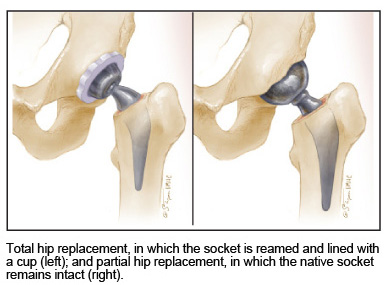
illustration of total hip replacement

In hip resurfacing, a metal cap is glued on the arthritic ball instead of replacing the ball itself. Some implant companies and surgeons have promoted hip resurfacing in recent years, but hip resurfacing has been around for many decades.

How are hip resurfacing and hip replacement different?

Hip resurfacing and hip replacement are similar. Both replace all arthritic surfaces in the arthritic hip. On the socket side, both operations entail removing a layer of arthritic bone and cartilage from the pelvis, and replacing it with a metal cup.

The main difference between hip replacement and hip resurfacing is what is done to the femoral bone (thighbone).

In hip resurfacing, the arthritic ball is prepared such that a metal cap is glued onto your bone. The diameter of the metal cap matches that of the artificial socket.

In hip replacement, the arthritic femoral ball is cut and replaced with a new ball. The inside of the femur bone is prepared to implant a metal stem 3 to 5 inches in length. On this stem, a mechanism allows attachment of a metal or ceramic ball that matches the size of the socket. Once the ball is placed into the socket, the hip replacement is complete.

Do hip replacement and hip resurfacing cost the same?

A hip resurfacing is more expensive because surgical time is longer and the implants are more costly. At present, the parts for hip resurfacing cost about twice as much as hip replacement parts.

What are the advantages of hip resurfacing?

The advantage of hip resurfacing is preservation of 1 to 2 inches of bone, on top of the thighbone. In theory, if you need repeat surgery in the future, this bone is available to the surgeon to work with.

This made sense in previous decades, when the lifespan of hip replacements was limited by material quality; the older synthetic ball-socket would wear out in 10 to 15 years. The wear particles would result in inflammation and bone loss around the implants. As a result, the implants would loosen, requiring repeat surgery.

Modern hip replacement bearings and implants are much improved though, and should outlast the lifespan of most patients. This assumes of course that the prosthetic parts are properly implanted and accurately aligned during surgery.

Also, today, if repeat surgery is needed on a prosthetic hip, modern metal technologies allow us to rebuild and reconstitute missing skeletal bone.

Therefore, the only advantage of hip resurfacing (preservation of an insignificant amount of femoral bone) when compared to hip replacement, has little practical value.

Hip resurfacing and replacement feel the same to patients, and are equally effective in relieving pain, restoring function, and restoring the ability to participate in any activity.

What are the disadvantages of hip resurfacing?

One, the metal cap must be glued to the arthritic femoral head. This glue can loosen up over time, causing the resurfacing to fail. There is no cement-less version of the metal cap in hip resurfacing.

Two, the bone directly underneath the metal cap, called the femoral neck, can break, especially if it is weakened during implantation of the metal cap. If this happens, urgent surgery is needed to convert the hip resurfacing to a hip replacement.

Three, hip resurfacing is more invasive than hip replacement. Since the femoral head is preserved in hip resurfacing, the surgeon has less room to work; therefore, the incision is longer and the surgical exposure is more extensive with hip resurfacing. Some surgical methods, such as the anterior surgical approach, allow hip resurfacing through a less invasive approach, but the operation is still more extensive than a hip replacement.

Four, the only kind of bearing in hip resurfacing is metal-on-metal. In hip resurfacing, the inside of the socket is a polished metal, and so is the metal cap that covers the femoral head. Actual hip movement in hip resurfacing is from metal-metal contact; this bearing is the only one possible in all modern hip resurfacings. Recent studies have raised a worry that metal-metal hip bearings can cause a reaction in some patients, requiring more surgery.

What are the advantages of hip replacement?

A key advantage is its longevity and track record. The technology used in modern hip replacements is safe and well-proven in millions of patients. The nuances, complications, surgical techniques, and outcomes of this operation have been thoroughly investigated. A properly performed hip replacement should outlast the patient; this is significant since no one wants repeat surgery.

Of note, different bearing surfaces can be used in hip replacement. This is because there is more latitude in the engineering design of hip replacement components. In hip replacement, once the metal shell and the femoral stem are implanted, the surgeon and patient have a choice of bearing, including metal-metal, metal-plastic, metal-ceramic, ceramic-plastic, and ceramic-ceramic.

Also, hip replacement bearings can be changed out several years after the surgery; the bearings are removable independent of the implants. In contrast, hip resurfacing bearings cannot be changed; the entire component must be removed, along with some bone, if a change of bearing is desired for any reason in the future.

What are the disadvantages of hip replacement?

The disadvantage, when compared to hip resurfacing, is that an additional 1 to 2 inches of bone at the top of the femur must be sacrificed. However, removal of this bone is of little, if any, practical consequence. If a hip replacement should ever fail, repeat surgery is relatively straightforward and predictable in the hands of an experienced surgeon. Also, we have many ways of making up for lost bone today; saving an inch or two of bone is of no clinical consequence over the long-term.

What if I choose to have hip resurfacing based on what I have read?

If a hip resurfacing is your choice, then that is the operation your surgeon should perform for you. In our practice, there is no preference or bias, nor any financial inducement toward one procedure or the other. The above comments are presented to share information known to professionals in our field, and may differ from claims made by hospitals and surgeons promoting hip resurfacing.

Filed Under: About Hip Replacement, HIP Tagged With: hip resurfacing

Leg Length

by

Can hip replacement surgery change your height?

You’d be surprised how often this question is asked, and the answer may surprise you!

If both hips are replaced, can you add height to my body?

Leg LengthYes. If both hips are replaced, it is possible to increase the leg length on one side and increase it by the same amount on the other side. But, any gain in height is about an inch or less. The limiting factor includes the muscles, tendons, and nerves, which only have so much stretch before there is injury or damage.

It is possible to replace both hips at the same time, if the patient is healthy enough for such surgery. Recovery from two hip replacements does not differ much from having one hip replaced, at least with newer, less-invasive surgical methods.

Will my leg be longer or shorter after hip replacement surgery?

This is an important topic, and should be understood before you embark on any hip replacement, no matter where you have the hip replacement done.

Hip resurfacing is an operation that is similar to replacement. During resurfacing, the arthritic ball is capped with metal, and an artificial socket is placed in the pelvis. Any bone removed is replaced with an equivalent thickness of metal in hip resurfacing, so there is no noticeable gain or loss in leg length during hip resurfacing.

In contrast to hip resurfacing, during hip replacement the arthritic ball is removed and replaced with a new ball. Since the artificial ball comes in different neck lengths, the surgeon is able to adjust muscle tension, leg length, and ball-socket stability during the hip replacement. These adjustments reflect complex decision-making and trade-offs during surgery. Rarely, because of anatomic constraints or other patient-specific reasons, slight leg lengthening may occur. If this is totally unacceptable, you should not consider hip replacement surgery.

In the overwhelming majority of cases, there is no change in leg length after hip replacement. In most cases where the patient feels a change in leg lengths, that perception will disappear over several months as the muscle and tissues stretch.

Can leg length be changed during hip replacement surgery?

Yes. An example would be a patient with a leg that was shortened from injuries after a motor vehicle accident, who now needs a new hip. In such cases, it is possible to restore the original leg length during surgery. The decision-making is complex, requires professional judgment, and is specific to each situation.

Likewise, if the patient has too long a leg before surgery, it is possible to shorten it during hip replacement, using specific surgical techniques that keep muscle tension within safe limits. Again, the exact steps taken and the decision-making are specific to each patient.

My leg ended up too long after a hip replacement. Can anything be done?

In most cases, with exercise, stretching, and healing over 6 to 12 months, the perception of a leg length difference will disappear on its own. During this time, to avoid a limp and facilitate walking, a shoe-lift built into the shoe can help.

The reason for waiting is that the majority of leg-length discrepancy after hip replacement is not a true difference in skeletal lengths. Rather, the discrepancy is from pelvic tilt, tight muscles, altered biomechanics, and even spinal arthritis that can lead to a curvature in the back. With muscles stretching, exercises, and time, such discrepancy will likely resolve in a few months.

If leg length discrepancy is permanent, additional surgery may be an option. During such surgery, the femoral stem component is removed, and the bone at the top of the femur is removed to equalize the leg lengths. Then, a new femoral stem is implanted.

While this sounds easy, additional steps must be taken to avoid improper muscle tensioning and to reduce the risk of creating hip instability and a limp. Recovery from this type of surgery is about 6 to 12 weeks.

How can we know if my leg is truly longer after a hip replacement?

Special X-ray studies can help determine if the perceived difference in leg lengths is really in the bone or arising from some other source, such as a tilted pelvis, a curvature in the back, or tight muscles. These X-rays, called scanograms, involve imaging the entire length of both legs with a measuring ruler that leaves no doubt about the actual length of each leg, from the top of the pelvis to the ankle.

Filed Under: About Hip Replacement, HIP Tagged With: height, xray

Treating Hip Arthritis

by

We compiled a list of some frequently asked questions about treatment for hip arthritis and hope you find it useful!

Will exercise help an arthritic hip?

Yes. Exercises strengthen the muscles around the hip joint. Weak muscles mean higher forces across an arthritic hip joint, and more pain. That is why regular, light aerobic exercise helps to relieve pain from arthritic hips. Recommended exercises include walking, swimming, elliptical exercisers, and similar activities.

Reasonable levels of exercise will not accelerate the wear and tear of an arthritic hip joint. Stronger and more conditioned muscles reduce the loads placed on the hip, and relieve pain. Exercise may help postpone hip replacement surgery.

One caveat: If exercise hurts, then refrain from that activity and try another form of exercise.

Does a cane help with an arthritic hip?

Yes. A cane in either hand helps, but is most effective if used in the hand opposite the painful hip. A cane reduces the load across the arthritic hip, thereby relieving pain and improving walking ability.

Will injections into the hip joint ease arthritic pain?

Yes, cortisone injections placed into an arthritic hip will ease pain temporarily. For mild cases of arthritis the injections may help for many months. However, injections cannot build up cartilage or otherwise cure arthritis.

Cortisone injections can also help pinpoint the source of hip pain, if there is any doubt where hip pain is coming from. If hip pain is really from hip arthritis, and not referred from a bad back or another source, then cortisone injections should relieve pain, even if temporarily.

Hip joint injections require X-ray imaging to guide the needle into the hip joint. This is why such injections must be done in a special procedure room, equipped with X-ray imaging equipment. If done in the clinic, these injections can be guided by ultrasound technology.

Lubricant injections that are marketed as “visco-supplementation” can help arthritic hip joints temporarily. However, they are more commonly used for treating arthritic knees.

Research to alleviate the pain and inflammation of hip arthritis is ongoing and exciting, such as injections using gold nanoparticles with mild radioactivity.

Is there surgery for hip bursitis?

Yes, if injections in the hip bursa do not work reliably, there is an arthroscopic technique, done as outpatient, that works very well using only a couple of small holes made in the skin. Pain relief is predictable with this small operation. Again, this applies to hip bursitis, which is very different from hip arthritis.

What else, other than surgery, can help an arthritic hip?

If possible, avoid stairs and concrete floors; weight lifting; deep bending at the hip; and repetitive impact exercises such as jogging, golf, and racquetball. Reasonable exercises include walking on a treadmill, swimming, low-impact activities, and upper-body conditioning. There are no effective braces for hip arthritis.

Will arthroscopic surgery help hip arthritis?

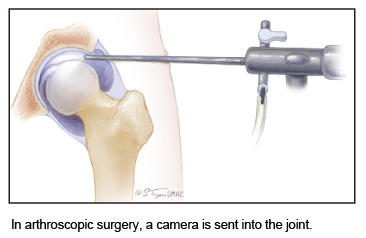
In mild or early hip arthritis, yes. Mild hip arthritis can result in hip cartilage tearing; this condition, called a torn labrum, can be addressed with hip arthroscopy. Arthroscopy refers to an outpatient operation, involving small skin openings through which a small camera and surgical instruments are introduced to trim torn pieces and clean up the joint. At the same time, the surgeon can remove bone spurs that physically impinge against each other, causing pain and stiffness.

But, if the arthritis is too advanced, then arthroscopic surgery may not be too helpful.

One benefit of arthroscopic surgery is the ability to look directly inside the joint and understand the extent of arthritic damage. With this information, a surgeon can advise on further treatment.

What is osteotomy of the hip?

camera use in arthroscopic surgeryOsteotomy refers to cutting bone and realigning the leg, to relieve the pain of an arthritic hip. By altering biomechanics favorably, the loads across the ball and socket joint are lessened. Osteotomy was once a commonly used surgical option in young patients, back when hip replacements were not suitable for young and active people.
In cases where the socket or ball is mis-shapen since birth and the arthritis is diagnosed early, osteotomy can help, especially in young patients. The surgeon can cut the femur and the pelvis to create a more aligned hip joint, thereby slowing the progress of arthritis.

Osteotomy is a complex, major procedure, and requires special skills that we offer in our practice. The goal of osteotomy in such cases is to preserve the patient’s own hip joint. Few patients are candidates for such a procedure, because in most instances, hip arthritis has progressed enough that a hip replacement is more desirable.

What is a hip fusion?

This is another hip operation that was more common in the past. It involves eliminating the hip joint, by surgically welding, or fusing, the ball to the socket. By eliminating movement in the hip joint, pain is relieved without using implants.

Hip fusion is also called an arthrodesis. Increased movement in the back and knee usually compensates for the stiff hip after the fusion.

Hip fusion is nearly obsolete now, since hip replacement surgery is so durable and predictable. But back in the days when hip replacements were not quite as advanced, hip fusion was worth considering for young patients.

Does weight loss help relieve arthritic pain?

Yes. Biomechanical studies show that body weight is multiplied 2 to 3 fold across the hip joint. Losing excess body weight relieves arthritic pain by unloading the joint. Weight loss also decreases surgical risks should hip replacement be necessary.

Will chiropractic manipulations help hip arthritis?

For some patients, chiropractic manipulations seem to help arthritic pain. Alternative remedies, such as glucosamine, vitamins, oils, yoga, hypnotism, herbal supplements, heat packs, ice packs, massage, aromatherapy, aqua therapy, prolotherapy, and acupuncture might also help. Use these remedies if you feel that they are helpful, and if you are familiar with their proper use.

If you are scheduled for surgery, stop all alternative medications and vitamin supplements at least 10 days before surgery. This is to avoid excess bleeding and risky interactions with the anesthetic drugs.

What about injections for hip bursitis?

Injections to the outside of the thigh are commonly used to treat hip bursitis. These injections do not enter the hip joint, and do not need X-ray guidance for accurate placement.

Hip bursitis is not related to hip arthritis. Bursitis is a local inflammation in the tissues near the hip joint, caused by muscles and tendons rubbing against each other. The pain from hip bursitis is located on the outside of the thigh, making it hard to walk or lie on that side. Hip arthritis, in contrast, is deterioration and inflammation of the ball-and-socket joint itself.

A visit to the doctor can usually help determine if you have bursitis or arthritis.

Should I use pain medicine for hip arthritis?

Medicines such as aspirin, acetaminophen, ibuprofen, naprosyn, and other anti-inflammatory drugs can be taken for a long time, within proper dose range. These medicines are not addictive. Your primary physician should monitor any possible side effects, especially if you take such medicines regularly.

Alternative remedies, such as glucosamine chondroitin, are available over the counter. These can help arthritic hips and can be used without risk of addiction.

Narcotic drugs can also relieve pain, but can create dependence and related psychological problems. Long-term use of narcotic drugs before surgery will make pain relief after surgery more difficult. If you regularly require narcotic medicines to control hip pain, it may be time to consider hip replacement surgery.

Why not replace the hip instead of trying nonsurgical measures?

Patients who invest the time to understand all options will know what to expect, and usually have the most satisfying outcomes. Nonsurgical treatment can give you time to learn more about hip arthritis and assess all treatment options.

Also, nonsurgical means of pain relief can work for a long time, at least for some patients; hip replacement surgery should be the last step.

Will arthroscopic surgery buy some time with an arthritic hip?

It could, depending on the extent of arthritis. In mild cases, with cartilage tears in the hip joint causing catching and pain, arthroscopy can buy time before a hip replacement. But if X-rays show advanced hip arthritis, arthroscopic surgery will probably not have any lasting benefit.

What is a hip resection, or Girdlestone, procedure?

This refers to a removal, or resection, of the diseased hip ball, and replacing it with nothing. Historically, this operation was done for conditions like tuberculosis of the hip, long before the days of modern hip replacement. The infected bone would be removed, and the hip cavity would be left empty.

Over time, the empty hip cavity would fill with scar tissue and the leg would shorten by a couple of inches, making walking very difficult. But, removal of the infected ball would give the patient a chance at healing the tuberculosis infection, and relieve pain.

Today, a Girdlestone resection in the hip is done very rarely. Circumstances in which the procedure is considered include a serious infection that cannot be eliminated otherwise, severe bone loss from multiple failed operations, muscle paralysis, or advanced cancer.

Filed Under: Featured, HIP, hip surgery Tagged With: arthrodesis, arthroscopic, bursitis, chiropractic, fusion, Girdlestone, osteotomy, resection

Arthritis and the Hip Joint

by

Here are commonly asked questions about arthritis and your hip joint.

What is hip arthritis?

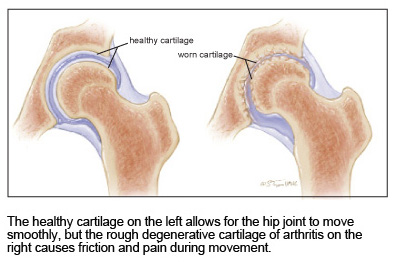
Arthritis is the roughening and destruction of the cartilage that lines the ball and socket. These rough surfaces generate friction and inflammation, causing pain and stiffness.

How do you diagnose arthritis or degeneration of the hip joint?

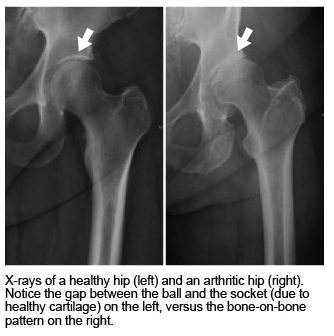
In many cases, a diagnosis can be made by X-ray studies and a physical examination. Damage to the hip creates a narrowing of the space between the ball and socket. Eventually, the hip can lose so much cartilage that bone touches bone, which can be very painful.

Early arthritis of the hip may not show up on an X-ray. In these cases, other studies, such MRI or CT scans, or an operation called hip arthroscopy, can help diagnose arthritis.

Where does one feel the pain of an arthritic hip?

Typically, pain from an arthritic hip will be felt in front of the thigh, to the buttock, or to the outside of the thigh. Pain may also travel to the knee due to overlapping nerves in the hip and knee joints. The pain and stiffness can usually be reproduced by rotating the leg. A painful hip can feel like a pulled groin muscle, or like a toothache in the groin.

Does hip arthritis always develop with old age?

Most people never develop hip arthritis, no matter their age. That said, everything in the body wears down with age, and hip cartilage is no exception. Those who need hip replacement surgery generally have a faster progression of hip arthritis because of injury, underlying inflammatory problems, genetic predisposition to arthritis, or a congenital abnormality of the hip joint.

What keeps the hip ball from popping out of the socket?

illustration of hip joint with and without arthritisMuscles, tendons, and ligaments hold the ball in the socket, preventing it from slipping or dislocating. Hip dislocation, usually associated with severe physical trauma, is a serious condition requiring immediate medical treatment.
Rarely, the hip joint is predisposed to dislocation and premature arthritis due to a congenital deformity. Newborns are now routinely checked to make sure their hip joints are properly formed.

What is a degenerative hip joint?

A hip joint is referred to as degenerative when the cartilage is damaged due to injury or a disease process, such as osteoarthritis or rheumatoid arthritis.

How does the hip joint get lubricated?

The hip joint is sealed in a capsule. This capsule is a tough tissue envelope surrounding the hip joint, much like the rubber seal surrounding a steering or suspension joint in a car. Cells inside the hip capsule secrete synovial fluid, which is a natural lubricant. In a healthy hip joint, there is always a small amount of this synovial fluid. The fluid serves as biological grease, and lubricates the joint.

Can hip pain be coming from other places?

Yes. What people think of as hip pain can come from other sources, like poor circulation to the leg, an arthritic back, an arthritic knee, painful sacroiliac joints, and other abdominal or pelvic problems. In other words, the problem may be elsewhere, but the patient may sense pain in the hip.

In older patients, hip pain can reflect more than one problem. For example, hip arthritis and back arthritis can occur together. In such patients, hip replacement surgery may help one source of pain, but other areas may also need treatment later.

Diagnosing Arthritis

Radiograph

Another word for an X-ray, which shows a silhouette of the skeleton. Although helpful for seeing bone, X-rays do not show muscles, tendons, and ligaments. An X-ray is usually the first imaging study of the hip joint when arthritis is suspected.

CT Scan

Also called a CAT scan. This is a computer-driven study that shows the three-dimension-al bone anatomy of the hip in greater detail than an X-ray, which is two dimensional. With contrast dye, CT scans can even show soft-tissue structure.

Indium/Gallium Scan

A specialized imaging study that can diagnose subtle infections in the joints, especially after the hip has been replaced with prosthetic components

x-ray of healthy hip and arthritic hip

Magnetic Resonance Imaging

Also called MRI, this study shows soft tissues such as tendons, muscles, and ligaments surrounding the joint.

Bone Scan

In this type of study, a radioisotope is injected into the body, with the goal of detecting infection, fracture, or related inflammatory conditions of bone.

Filed Under: HIP, hip surgery Tagged With: arthritic, arthritis, diagnosis, scan

  • « Go to Previous Page
  • Page 1
  • Interim pages omitted …
  • Page 11
  • Page 12
  • Page 13

Primary Sidebar

ORTHO NEWS

Spinal anesthesia tied to increased opioid use after hip surgery

Spinal anesthesia tied to increased opioid use after hip surgery

Useful Health Tips for People With Chronic Hip Issues

Useful Health Tips for People With Chronic Hip Issues

A robotic assistant for joint replacement surgery

A robotic assistant for joint replacement surgery

Prior Diagnosis of COVID Has No Increased Complications in Total Joint Arthroplasty

Prior Diagnosis of COVID Has No Increased Complications in Total Joint Arthroplasty

Putting Your Best Foot Forward for Joint Surgery Success | Health

Putting Your Best Foot Forward for Joint Surgery Success

Use of Antibiotic Lavage in Total Knee Replacement to Prevent Postoperative Infection

Use of Antibiotic Lavage in Total Knee Replacement to Prevent Postoperative Infection

Tips to care for an elderly after hip replacement surgery

Tips to care for an elderly person after hip replacement surgery

Exactech Total Knee Failure Resulted in Revision Surgery, Lawsuit Alleges

Exactech Total Knee Failure Resulted in Revision Surgery, Lawsuit Alleges

AAOS Updates Clinical Practice Guideline for Surgical Management of Osteoarthritis of the Knee

AAOS Updates Clinical Practice Guideline for Surgical Management of Osteoarthritis of the Knee

Robotics Procedure Helping People Recover From Joint Replacement Surgery

Robotics Procedure Helping People Recover From Joint Replacement Surgery

Copyright 2014 All Rights Reserved · DISCLAIMER: Nothing here constitutes legal, medical, or other advice; all content relates to an individual perspective only. A professional relationship with a physician, or with a lawyer is built over time, with mutual investment, trust, and respect. This site is not a substitute for that.
~ THIS DOMAIN IS FOR SALE ~

Privacy Policy